I started working at UvA in October on a postdoctoral research project focusing on the commemoration of the dead in late antique Egypt. That project is funded by the Van Moorsel en Rijnierse foundation, which aims at promoting research on Christianity in the Nile Valley from the Byzantine to the Mamluk period. Having completed a doctoral thesis on festivals in late antique Egypt, including of course Christian feasts, my interests fitted the scope of the fellowship perfectly, and I was eager to expand the kind of liturgical and socio-economic research I did in my thesis.
This project provides the first comprehensive study of the Christian commemoration of the dead in Egypt between the 4th and the 8th centuries. This observance encompassed a wide range of liturgical, social and economic arrangements for remembering deceased individuals, taking place over a long period of time after death and burial itself. It involved all strata of society, be they men or women, monks, clerics or lay people. The aim is to show how this widespread, but understudied phenomenon, impacted the lives of the late antique Christians in Egypt, both at an individual and societal level.
This topic has been scarcely addressed at all, mainly for two reasons: first, the accessibility of Egyptian evidence, which encompasses not only literary but also liturgical, papyrological and epigraphic sources, both in Greek and Coptic; second, the evasiveness of that type of celebration, whose existence can typically be inferred only from allusions to commemorative offerings or provisions made for that purpose. I will first compile a corpus of all the available written sources that mention or allude to the commemoration of the dead. These include, on the one hand, normative and liturgical texts: monastic rules (mainly those of Pachomius and Shenoute), sayings of the desert fathers, church canons, some saints’ lives and martyrdoms narratives; books of prayers, intercessions for the deceased. Documentary sources, on the other hand, comprise first and foremost papyri and ostraca: wills, private letters, expense accounts, lists of days or individuals to commemorate, acts of donation, loan agreements, petitions. Commemorative inscriptions and graffiti, though fewer in number, provide insights into the public dimension of the celebration, some of them bearing witness to the collective commemoration of groups of people.
My first step will be to obtain a full picture of the practice. Who are the deceased and who are responsible for their commemoration? When is the commemoration held? Where does the commemoration take place (home, tomb, church)? (4) What are the prerequisites for commemorating the dead and what is their value? Offerings seem to have been mandatory, either provided by the deceased by testament, or made on their heirs’ own volition. (5) What liturgical rites and social gatherings mark the commemoration (religious services, prayers, communal meal, the reading of the name)?
I will then explain why and how the commemoration of the dead constitutes a central feature of the private and collective lives of the Egyptian people. A socio-economic analysis will question in particular how gender and religious condition affect the care for the deceased and the economic impact of that kind of rite on the individuals and the individual communities. A good portion of the relevant sources relates to lay people and women, whereas ancient sources in this area overall mainly concern men and especially monks, which explains the monastic focus that has traditionally been a hallmark of studies on late antique Egypt (Schenke 2025). The project will offer a more nuanced and comprehensive view of Egyptian society, reflecting its diversity. This will be achieved by framing the commemoration of the dead within the wider social context and by including it within the description of daily life of, e.g., women (Wilfong 2002) and villagers (Ruffini 2018).
Finally, the project will explore the relation between commemoration and public festival. Commemorations are private in nature, since they are contingent on the death of an individual, but they are also public ceremonies attended by a larger local lay or monastic community. Some commemorations, held for those who had attained sainthood, developed into proper public feasts. Three Egyptian case studies show how this development persisted in a later period: the cults of Apollo and Phib at Bawit, Ieremias at Saqqara and Lots at Dayr Abu Hinnis display features of a true cult of saints, while also retaining some aspects of a commemoration (Papaconstantinou 2001; Delattre 2021). Based on the in-depth analysis of the private practices, I will be able to question the ways in which the more public festivals took over or partook in them.
Overall, the commemoration of the dead was a celebration that shaped the lives of individuals not only throughout their lives, but also multiple times a year, for it required them to make plans for their own commemoration or organising and attending that of deceased relatives and community members. And for that reason alone I couldn’t be happier to carry out this project in Amsterdam, where I will work in close relationship with the members of the Lived Time project.
Élodie Mazy
References
Delattre, A. 2021. “Graffiti from Christian Egypt and the Cult of the Saints. A Case Study from Dayr Abu Hinnis”. In: B. Ward-Perkins and A.E. Felle (eds), Cultic Graffiti across the Mediterranean and Beyond. Turnhout, pp. 103–110.
Papaconstantinou, A. 2001. Le culte des saints en Égypte des Byzantins aux Abbassides. L’apport des inscriptions et des papyrus grecs et coptes. Paris.
Ruffini, G.R. 2018. Life in an Egyptian Village in Late Antiquity. Cambridge.
Schenke, G. 2025. “Coptic Papyrology (2016–2022): Primary Evidence of Egyptian Lives”. In: A. Delattre, E. Mazy, P. Pilette and N. Vanthieghem (eds.), Proceedings of the Twelfth International Congress of Coptic Studies (Brussels, 11–16 July 2022). Paris, pp. 263-272.
Wilfong, T.G. 2002. Women of Jeme. Lives in a Coptic Town in Late Antique Egypt. Ann Arbor.
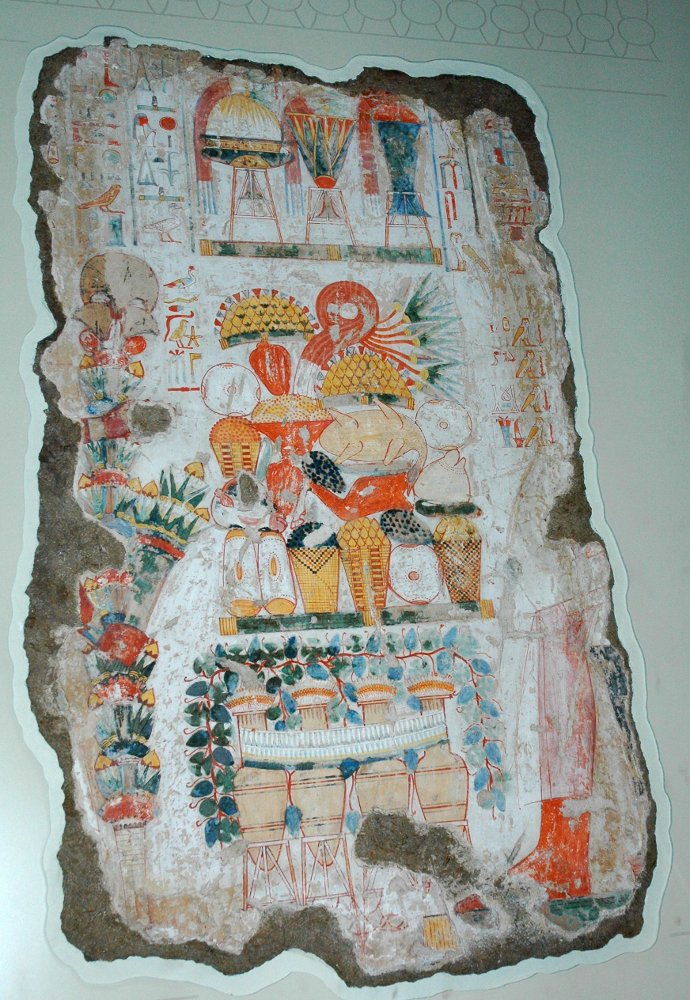
Thebes, Tomb of Nebamun, ca. 1397–1351 av. J.-C. (Ancient Egypt Gallery, British Museum, London)
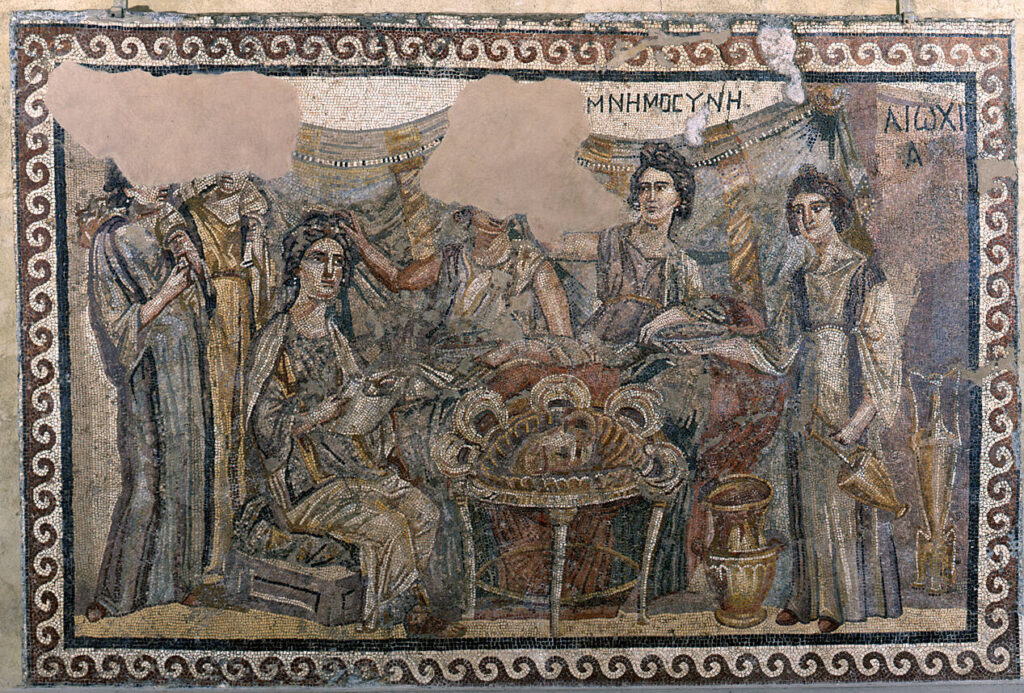
Antioch, Necropolis, late 4th c. (Worcester Art Museum 1936.26)