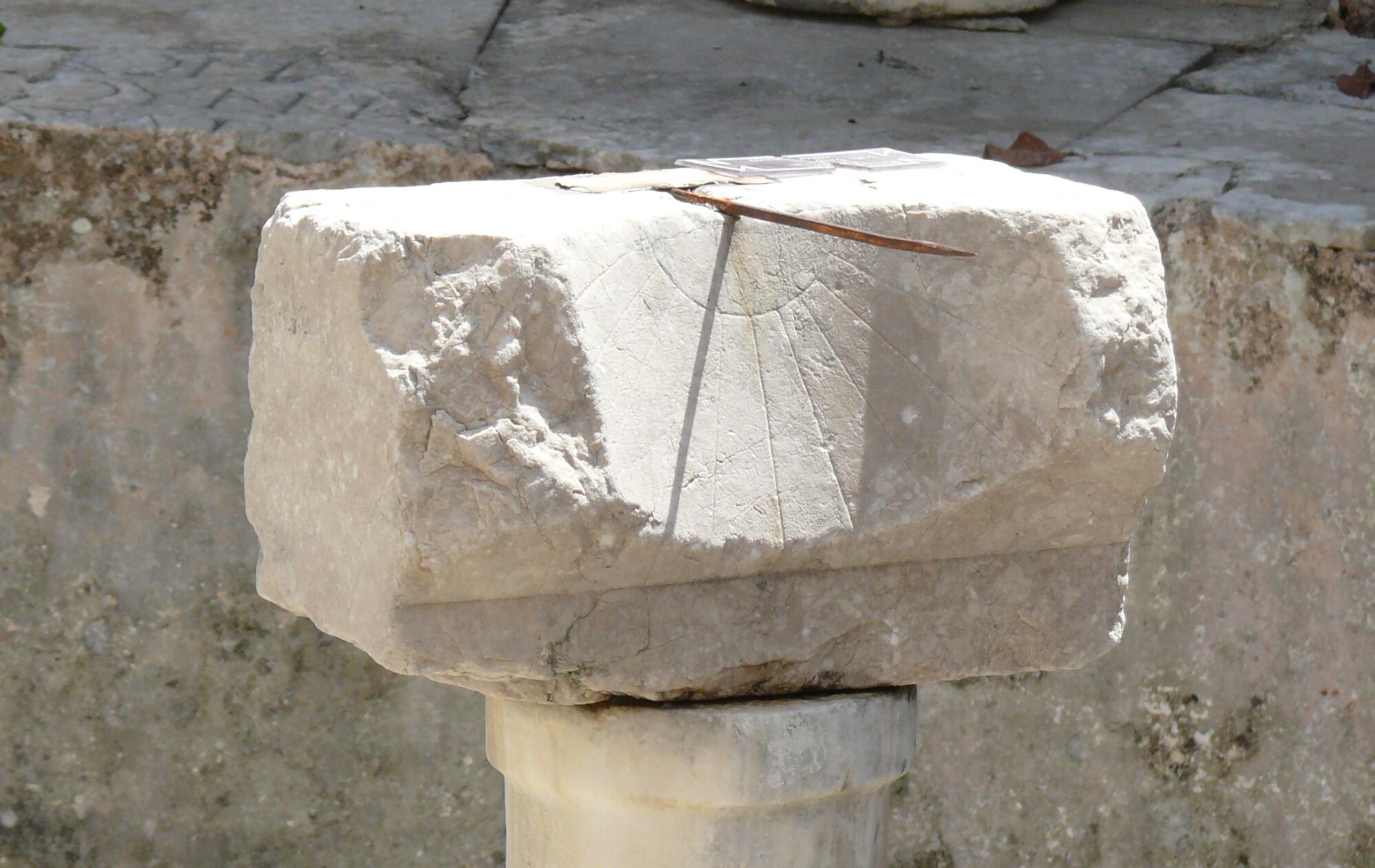
A few weeks ago, people from all over the world travelled to Spain, in order to see the total solar eclipse of 12 August 2026. During such an eclipse the moon completely obscures the view of the sun from part of the earth (the location from where it is visible follows a curved path). Here in Amsterdam, we only saw a partial eclipse, which reached its maximum at 20:10 and had an obscuration of 88,26%. This natural event reminded me of the total solar eclipse in northern Egypt on 10 March 601, which is recorded on an ostracon from southern Egypt.
The ostracon, a limestone flake measuring 10 × 9 × 2 cm, is on display in the Writing Gallery of the Egyptian Museum in Turin (Cat. 7134; figs 1-2). The website of the museum does not explain how it entered the collection, but according to A. Delattre (2025), it was “bought by Drovetti in the Theban area”. The Italian Bernardino Drovetti, who collected antiquities during his position as French Consul-General in Egypt (1802-1815) and was particularly active in and west of Luxor (ancient Thebes), sold his first collection in 1824 to King Charles Felix of Sardinia, who housed it in a new museum in Turin.
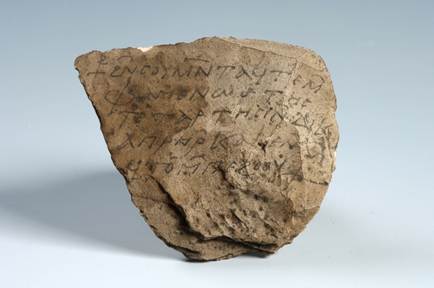
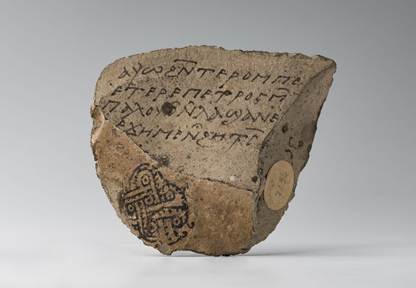
The text, written in black ink in 5 lines on the front and 4 on the back, has been edited several times (Stern 1878; Rossi 1894-1895; Gilmore and Ray 2006; Heurtel 2013). In papyrological studies and online resources it is referred to as SB Kopt. II 1238 and TM 85157.
The Coptic text on the front reads: ‘+ On day 14 of (the month) Phamenoth in the 4th indiction year, the sun darkened at the 4th hour of the day +.’ After marking the end of the note by a cross, the scribe wrote on the back as an afterthought: ‘And (this happened) in the year when Petros, son of Palou, was headman of Djeme’. Instead of a cross he drew a decorative motive (a slightly irregular Solomon’s knot) below the text. On the righthand side he added five signs with the same ink – a detail not mentioned by the editors. Some of them look like letters or numerals without cohesion (horizontally: ⲑ, ⲟ, ⲁ or ⲯ; vertically: ⲋ = 6), but together they seem to form an unhappy face.
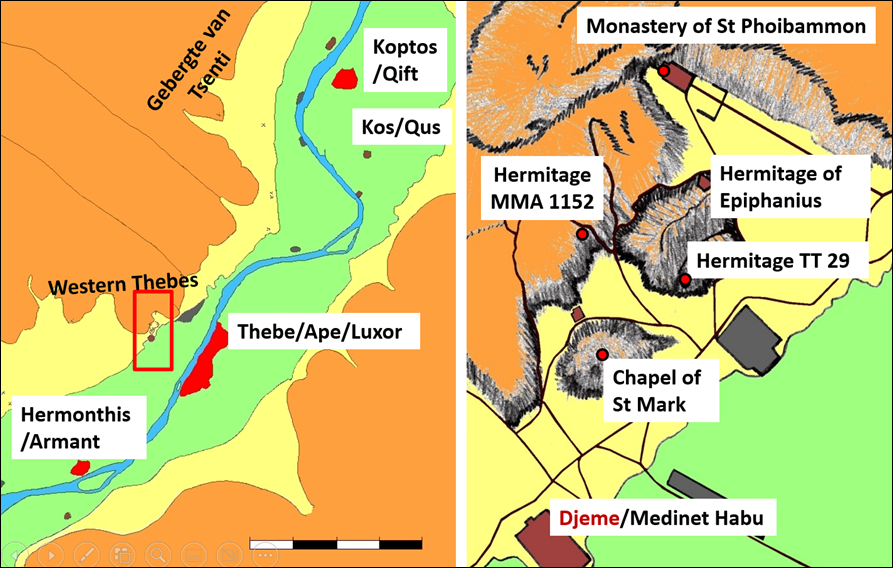
The text thus records a solar eclipse that was visible in Djeme, a village that existed in and around the ancient mortuary temple of Ramesses III at Medinet Habu in Western Thebes from the sixth to the eighth/ninth centuries (fig. 3; on Djeme, see also this blog).
In regular years, 14 Phamenoth corresponds to March 10 (Julian). The absolute date is more difficult to establish, since the 4th indiction year referred a taxation cycle that restarted every 15 years. We need to know which 15-year period is referred to. Fortunately, the information on the solar eclipse is so specific that the astronomers H.H. Turner and J.K. Fotheringham could link the description – ‘with unusual certainty’ – to the solar eclipse in Egypt on 10 March 601 (Crum 1902: xvi n. 3). Astronomer G. Gilmore and Egyptologist J. Ray confirm that this ‘was the only total solar eclipse over the lower Nile Valley in the period between 570 until 738’, and that total obscuration was visible roughly between modern Cairo and Minya. According to their calculations, the maximum at Cairo occurred at 9:55 and lasted for 2 minutes and 26 seconds, which is quite long (Gilmore and Ray 2006: 191).
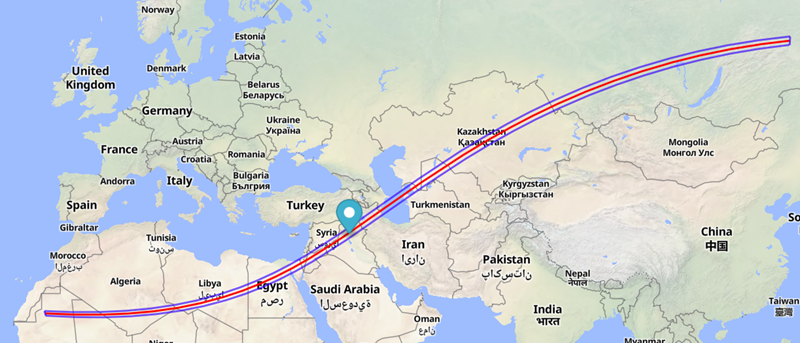
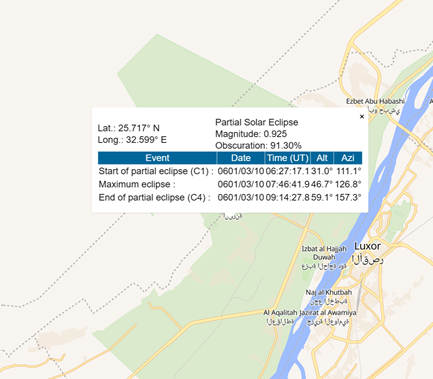
At Djeme, there was no total eclipse, so the darkening of the sky would have been more subtle, though obviously still significant to the scribe. A tool on the NASA website displays the eclipse path and enables the viewer to zoom in on specific sites and see local details of the eclipse, based on calculations by Fred Espenak, expert at NASA’s Goddard Space Flight Center (see fig. 4). For the location of Djeme/Medinet Habu, it suggests that a partial solar eclipse was visible from this location, with an obscuration of 91.3% and a maximum eclipse at 7:46 UT(C), which corresponds to 9:46 local time (fig. 5). Gilmore and Ray list slightly different numbers: a coverage of 93% and a maximum eclipse at 9:57. Both 9:46 and 9:57 correspond with ‘the 4th hour of the day’, the time recorded in the inscription: since the 1st hour started with local sunrise, a few minutes after 6:00, the 4th hour roughly corresponded to the period between 9:00 and 10:00.
The scribe does not identify himself, but A. Boud’hors and C. Heurtel have recognised the distinctive handwriting of Mark, priest of the Chapel of St Mark in Western Thebes, on a hill north of Djeme, whose ostraca they edited (O.Saint-Marc 1-49; fig. 3). He was also active as a scribe at the hermitage of Epiphanius further north, where he left a monumental inscription inside the hermit’s cave and a work contract for a camel herd. He was closely associated with Bishop Pesynthios of Koptos in the 620s (Dekker, Episcopal Networks, 111-113; on the bishop, see also this blog. If Mark did indeed record the eclipse of 601, he had apparently already started his training as a copyist (in view of his book hand), but it is unclear where he lived at the time and if he was already ordained priest.
Why did Mark record the event? Being aware that eclipses were considered a bad omen in antiquity, Gilmore and Ray argued that the scribe (at the time not yet identified as Mark) ‘clearly felt the need to surround the text with signs of the Cross, in an attempt to invoke divine protection’ and possibly felt uneasy about the numerical pattern of the date: the 4th hour on the 14th day of a month in a 4th year. If Mark felt uneasy (perhaps reflected by the unhappy face), this was not the reason for the symbols he added to the text: Christian letters usually start and end with a cross or staurogram. The Solomon’s knot reappears in various forms on drawing practices from the nearby Monastery of Apa Phoibammon (fig. 3). Furthermore, the number 4 has positive Biblical associations: four corners of the world, four rivers of Paradise, four evangelists, four Living Creatures around God’s throne (the number 14 appears less often, without strong connotations). It is more likely that Mark was reminded of the darkness by day while Jesus was on the cross and of Jesus’ announcement that cosmic disturbances, including solar and lunar eclipses, will mark his Second Coming for the Last Judgement.
Whether or not Mark felt uncomfortable during the eclipse, or was just surprised by its unexpected occurrence, he took the time to write neatly and to draw the Solomon’s knot in detail after the event, perhaps as a scribal exercise or as a note out of personal interest.
When it comes to solar eclipses, history repeats itself. On 2 August 2027 a solar eclipse will be visible in an unusually large part of Egypt, from the northwest (12:42) to the southeast (13:15). Viewers from Luxor may expect total obscuration at 13:05, with a magnitude of 1.036 – greater than in Spain this year (1.016 on average) as well in Egypt in 601 (1.016 near Beni Suef). So eclipse enthusiasts, do not forget to buy your flight on time, for the ‘Total Solar Eclipse Countdown’ has already started!
Renate Dekker
Bibliography
https://eclipse.gsfc.nasa.gov/ [eclipse predictions by Fred Espenak (NASA’s GSFC), which also displays path maps and details of historical eclipses. Remarkably, the eclipse of 601 is not included in the list of historical eclipses, https://eclipse.gsfc.nasa.gov/SEhistory/SEhistory.html].
O.Crum = Crum, W.E., Coptic ostraca from the collections of the Egypt exploration fund, the Cairo Museum and others: the texts, London 1902.
O.Saint-Marc = A. Boud’hors and C. Heurtel, Ostraca et papyrus coptes du Topos de Saint-Marc à Thèbes, Le Caire 2015.
SB Kopt. II = Hasitzka, M., Koptisches Sammelbuch, vol. II, Vienna 1993.
Dekker, R., Episcopal Networks and Authority in Late Antique Egypt: Bishops of the Theban Region at Work, Leuven 2018.
Delattre, A., ‘Papyrologists at work: Coptic papyri and the history of late antique and early Islamic Egypt, in: S. Töpfer a.o. (eds), Coptica Taurinensia: Coptic papyri from the Museo Egizio. Proceedings of the 7th International Summer School in Coptic Papyrology, Turin, 4th-9th September 2023, Turin 2025, 8-24.
Gilmore, G., and J. Ray, ‘A fixed point in Coptic chronology: the solar eclipse of 10 March, 601’, Zeitschrift für Papyrologie und Epigraphik 158 (2006), 190-192.
Heurtel, C., ‘Trois ostraca supplémentaires de la main du prêtre Marc’, in: C. Louis (ed.), Études coptes XII: quatorzième journée d’études (Rome, 11-13 juin 2009), Paris 2013, 77-79.
Rossi, F., ‘Di acuni cocci copti del Museo Egizio di Torino’, Atti Torinese 30 (1894/1895), 799-807.
Stern, L., ‘Sahidische Inschriften’, Zeitschrift für Ägyptische Sprache 16 (1878), 9-28.