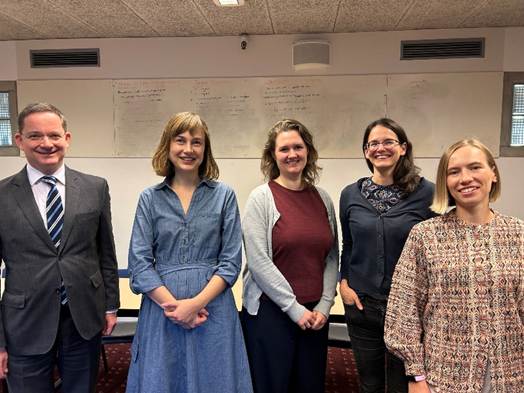
On the 8th of October, the Lived Time Project – and in particular Elsa Lucassen – organized the workshop ‘Marking the Time’ on festive culture in Roman and Byzantine Egypt. Our aim was to get a better understanding of long-term continuity and change by bringing together international experts on different periods and subjects. It was a very interesting and productive day!
After a short introduction on the topic of festivals as markers of time and identity by Elsa Lucassen, Elena Chepel discussed a range of temporal aspects of festivals. In her presentation she discussed many interesting papyrological sources that are also relevant to the Lived Time project, including topics such as the special position of the first day of the month, free days for festivals, specific rules attached to festive periods, and the relation between festivals and divination practices.
The next speaker was Harald Buchinger, who discussed the development of the liturgical year in Alexandria. After stressing that the liturgical year as a coherent system of feasts was an innovation of the end of the fourth century, he considered a broad scope of Alexandrian sources on Epiphany and Easter. He concluded that even after the formative period at the end of the fourth century and the beginning of the fifth century, there was still ongoing diversity in liturgical practices and that the actual implementation of these Christian feasts happened only during the fifth and sixth centuries in Alexandria.
After lunch, Sofie Remijsen discussed the development of the seven-day week, stating that astrological, Jewish and Christian traditions were all interconnected as part of a shared religious landscape. As examples, she talked about how the introduction of the Sunday as a closing day for the courts reacted to older customs, and discussed evidence for non-Jewish interest in the Sabbath in Roman Egypt.
Elsa Lucassen spoke on the feasts at the start of the Egyptian Harvest season, including the Serapeia, Easter and the Feast of Pharmouthi, and their possible interconnections. This presentation touched upon an important topic of her PhD project, where she states that most feasts were closely connected to the seasons, showing that even innovative celebrations retained the festive rhythm and continued familiar festive traditions.
Lastly, Ágnes Mihálykó gave an extensive overview of relevant liturgical sources including hymns, calendars, and vigils. Only from the sixth and seventh centuries on, we start to find sources that are directly related to what happened during services. Only in the tenth century that we find specific instructions. After a discussion of different sources on calendars, she reviewed several festive practices, such as festive meals, vigils and processions.
We again extend our gratitude to all participants for their stimulating contributions!
Elsa Lucassen